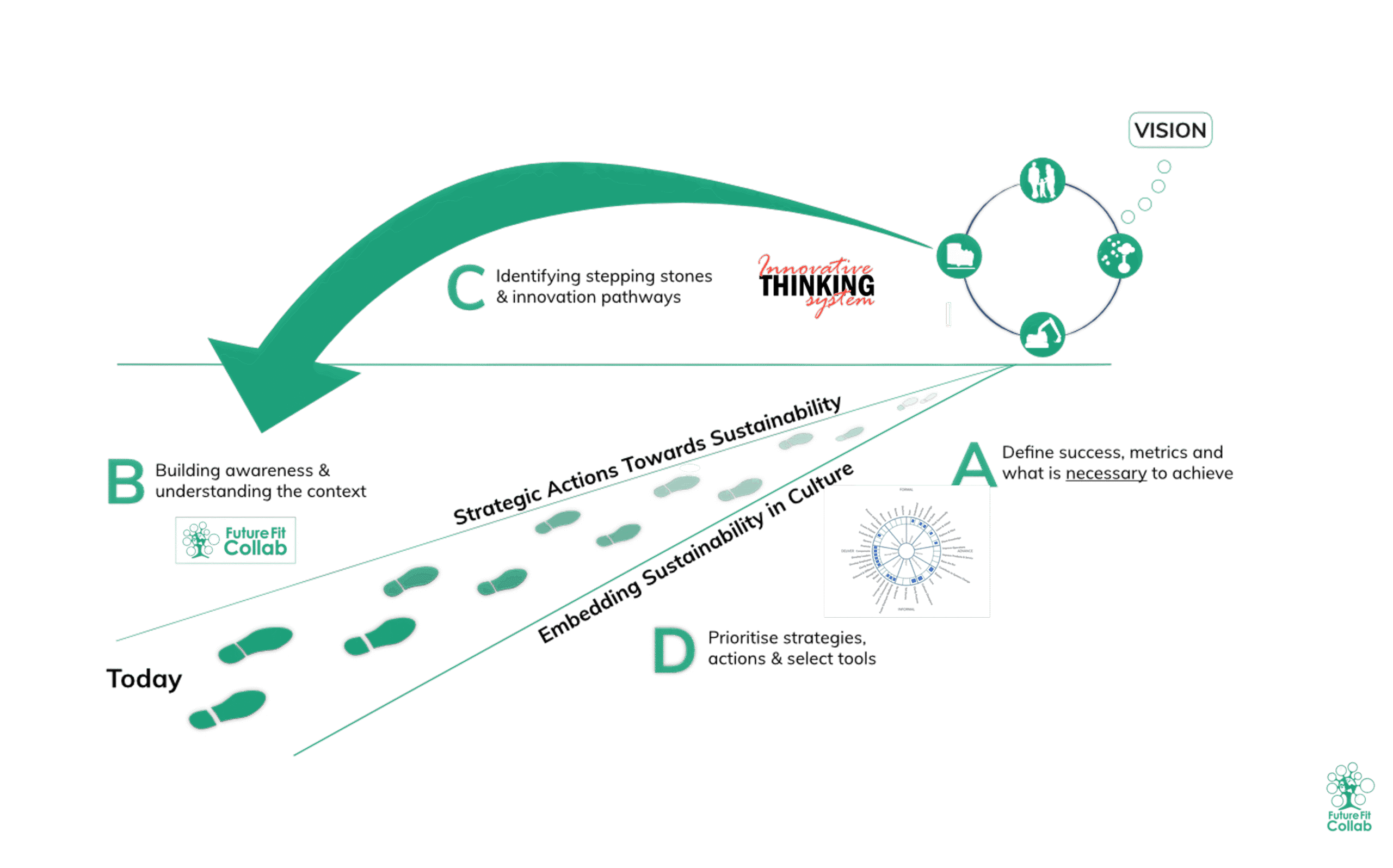
A unifying framework that brings everything together — Planning for sustainability.
Imagine you’re working hard on sustainability: you’re segregating waste, installing solar panels, or organizing a cleanup campaign. It’s all good, but does it sometimes feel like a drop in the ocean? Like you’re treating the symptoms, but missing the bigger picture?
That’s because sustainability isn’t a checklist. It’s a fundamentally different way of operating. And without a coherent strategy, these remain isolated actions that consume a lot of energy but yield little in return.
Does this sound familiar?
- One department does something different than another.
- You’re not sure which action truly has the greatest impact.
- You communicate one thing, but the reality often tells another story.
Now imagine this:
An approach where everything does work together. Where everyone – from leadership to frontline teams – speaks the same language and moves in the same direction. Where you can explain your choices more easily to residents, customers, or your own colleagues. That’s what planning for sustainability is all about!
Continue reading
This is what you gain:
- More impact with the same energy: Your actions reinforce each other instead of competing.
- Less hassle: A clear plan prevents confusion and internal friction.
- Future resilience: You respond smartly to new regulations, shifting expectations, and resource scarcity.
- A story that holds up: You can proudly and honestly explain what you do and why – strengthening trust in your organization.
Whether you’re a LGU, university or a business: sustainability is no longer a side issue. It’s the core – about how you prepare your city for the future, or how you make your company future-proof. An integrated approach isn’t a luxury here; it’s your secret weapon. It’s the roadmap that replaces chaos with focus, and turns good intentions into measurable results.

The Framework for Strategic Sustainable Development (FSSD)
Over the past years, we have built on a solid foundation: the Framework for Strategic Sustainable Development (FSSD), made globally known through The Natural Step. This scientifically grounded framework helps organizations plan for sustainability, make clear choices for a future within the planet’s carrying capacity, and consider human needs. It makes complex sustainability challenges manageable and translates them into concrete strategy, policy, and action.
As we climb mount Sustainability, with the Sustinability Principles at the top, we are doing better than ever on bottom line business. This is not at the cost of social or ecological systems, but at the cost of our competitors who still haven’t got it.”
Former CEO, Interface
FSSD has managed, like few others, to develop an operational model, which can be applied within business, so one can go from knowledge to solution. And that bridge is exactly what is needed.
It was not until ten years later wehn we fully realized how much money we had saved and earned from applying Framework for Strategic Sustainable Development to our business.
Chairman | AstraZeneca, Former CEO | Electrolux, Former President and CEO | Volvo Group
Your path to sustainable impact
Every sustainability journey is unique. Your approach depends on questions such as: What have you already set in motion within your organization? What opportunities do you see in the market? What do your stakeholders expect? And which regulations are relevant to you?
Together with you, we explore what works best right now. How you can plan for sustainability in the most effective way. Our goal is for you to take charge as soon as possible. Because when sustainability truly fits your culture and way of working, the greatest impact emerges – and you reap the most significant benefits.
Below you’ll find some examples of our approach:
- International roller coaster manufacturer with 350 employees.
- A LGU in the Netherlands with 164,000 inhabitants.
- A housing association with 33,000 social rental homes.
Building a Sustainable Future Together: The Coaster for Tomorrow Journey
We started at the foundation: the international roller coaster company with 350 employees. Through conversations with key roles across all layers of the organization, we mapped out what made the company unique- from engineering to project management, from design to customer relationships. During a multi-day workshop on-site, we pieced the puzzle together. Everyone’s technical knowledge and hands-on experience converged to lay a solid foundation for a sustainable path forward.
Together, we then developed a future vision as ambitious as the company’s attractions: What would a resilient, sustainable roller coaster builder – that leads the way globally – look like? We translated these shared ambitions into a clear and inspiring perspective. Then, we defined the route: what innovations, material choices, and process improvements were needed to realize that vision and create an ESG reporting tool? This was the moment to think outside the box and show boldness.
We made it concrete with a tailored roadmap. The organization received a clear overview with actionable plans they could start implementing immediately. From that moment on, management took the wheel – with confidence, a solid plan, and the first steps to genuinely set the company in motion. Just like the company’s attractions: first the design, then the build, and then the ride to success.
A Municipality on the Path to Sustainable Impact: A Practical Story
In a Dutch LGU with 160,000 residents, we undertook an intensive year-long journey together with the organization. We started by supporting colleagues in mapping out their teams, departments, and projects. This collaborative analysis laid the groundwork for four strategic sessions, which resulted in a detailed and widely-supported action plan.
We then supported city council in steering the program and establishing the right processes. As a coach and sparring partner, we stood by their side during implementation. Through a tailored eLearning program and a comprehensive communication strategy, we ensured that all 1,500 employees began speaking the same language about sustainability.
After twelve months, the colleagues felt ready to take full ownership of the responsibility. We remained involved as supporters on the sidelines – ready for questions and to collaborate on more complex challenges. In this way, the LGU grew in just one year from an initial exploration to an independent, powerful approach that the entire organization stands behind.
From isolated projects to a well-oiled sustainability machine
At a housing association facing complex challenges related to maintenance, renovation, and new construction, sustainability initially played a subordinate role. Even though it needed to be addressed in every project – from design and procurement to health, maintenance, and livability – a coherent approach was missing. Initially, the association engaged us on a project-by-project basis to fill in the sustainability section. At that time, sustainability was still an “add-on” rather than an integral part of the way of working.
We developed an intensive training program for 16 employees with diverse skill sets. Over four sessions, supported by coaching and reflection meetings, they grew within just a few months into sustainability experts who could each guide their own projects. In this way, sustainability was no longer a separate chapter but a logical part of daily practice.
In the years that followed, we continuously trained new employees, ensuring that knowledge was retained even through staff turnover. The result? Sustainable thinking is now fully embedded in the organization, and the sustainability transformation of thousands of homes runs like a well-oiled machine.
FSSD Inside
Over the years, we have had the privilege of helping many organizations plan for sustainability and apply the FSSD in various ways. To the side, you’ll find some of these organizations. For a comprehensive overview, you can click here.


Want to quickly learn how to plan for sustainability?
Systems Thinking Workshop
Everything is interconnected. How do we create Creative Sustainable Solutions in an immensely complex world? This 1-day workshop helps you get started!

Sustainable Culture Training
This 2-day certificate training teaches you how to leverage all facets of cultural embedding to create lasting impact with everyone's participation.
Planning for Sustainability Training
Are you on the verge of developing or revising a sustainability strategy for your company or municipality? Learn how in this international training.

Frequently Asked Questions
What is strategic planning for sustainability?
Strategic planning for sustainability is about developing a coherent, integrated action plan. It is the opposite of working with a checklist or implementing isolated initiatives. The goal is to connect all your efforts into an effective long-term strategy.
This is important because it ensures that all your efforts work in the same direction. This leads to:
- Greater impact with the same energy: Your actions reinforce each other instead of competing.
- Future resilience: You are better prepared for new regulations, scarcity, and changing expectations.
- Fewer internal conflicts: A clear, widely supported plan prevents confusion and ensures a shared direction.
- A credible narrative: You can communicate your choices clearly and transparently, which builds trust.
What is the Framework for Strategic Sustainable Development (FSSD)?
The Framework for Strategic Sustainable Development (FSSD) is a scientifically grounded model. It translates complex sustainability challenges into concrete strategies and action plans. It has gained worldwide recognition through The Natural Step.
The primary goal of the FSSD is to help you approach planning systematically, based on the premise of a future within the planet’s ecological and social carrying capacity. It makes abstract goals manageable and provides a common language for everyone in your organization.
What are the concrete steps in a process?
A process does not follow a fixed template but follows a logical sequence tailored to your unique situation. The core consists of these three phases:
| Phase | Core Activity | Purpose & Outcome |
|---|---|---|
| Analysis & Foundation | Conducting conversations with key figures from all levels of your organization. Mapping your current situation, core strengths, and opportunities. | You create a shared starting point and a solid foundation for your strategy. |
| Vision & Route | Jointly developing an ambitious future vision and translating it into a concrete path with required innovations. | You define the shared goal on the horizon and the key steps to get there. |
| Implementation & Integration | Developing a detailed roadmap with action plans, supporting your management, and training employees. | You drive actual progress, ownership, and the integration of sustainability into daily practice. |
How do I choose the right approach for my organization?
The best approach is determined by your current position, opportunities, and specific context. There is no standard solution; the process is always customized to fit your needs.
Your approach depends on questions such as:
What has your organization already set in motion?
What opportunities and expectations exist in your market or among your stakeholders?
Which laws and regulations are relevant to you?
What aligns with the culture and way of working within your organization?
The ultimate goal is for your organization to take charge as quickly as possible. Real impact only emerges when sustainability aligns with the culture and daily practices.
Which trainings are available to learn how to plan yourself?
If you want to work on it yourself as a professional, there are specific trainings that go deeper into the methodology:
Sustainability Planning Training: A training for when you are about to develop or revise a sustainability strategy.
Systems Thinking Workshop: A one-day workshop that helps you understand interconnections and find creative solutions in a complex world.