

Sustainable Culture
from strategy to embedding sustainability
The power of a sustainable organizational culture.
Imagine you have a clear sustainability strategy. The goals are defined, and the plans are ready. But as soon as you start implementing, you notice it doesn’t run smoothly. Some teams are enthusiastically on board, others disengage. Things feel sluggish in practice. Why? Because real change isn’t just about policy.
Sustainability only truly comes to life when it becomes part of the organizational culture – in how people think, make decisions, and collaborate. And a sustainable culture cannot be enforced by rules or targets alone. It requires attention to both formal and informal behavior:
Formally, in policies, roles, and systems that enable sustainable action.
Informally, in the small daily choices, conversations by the coffee machine, and the example set by leaders.
That’s where the key lies. When management and HR work together to build a sustainable culture that supports people (cultural embedding), it stops being an isolated project and becomes a way of working. HR can align recruitment, development, and rewards with sustainable behavior. Leadership can set the tone and create space for innovation. This creates an environment where people dare to experiment, are allowed to make mistakes, and learn together.
”Continue
The result of a sustainable culture?
- Sustainability becomes second nature. Not an “extra,” but the way you work.
- Innovation gets room to breathe. Teams actively seek smart, sustainable solutions.
- Results endure. Because behavior, processes, and strategy reinforce each other.
Whether you’re a LGU, university or a business: embedding sustainability into your culture makes the difference between a plan on paper and lasting change in practice.
Culture isn’t a soft or secondary matter – it’s the engine that brings a sustainability strategy to life.
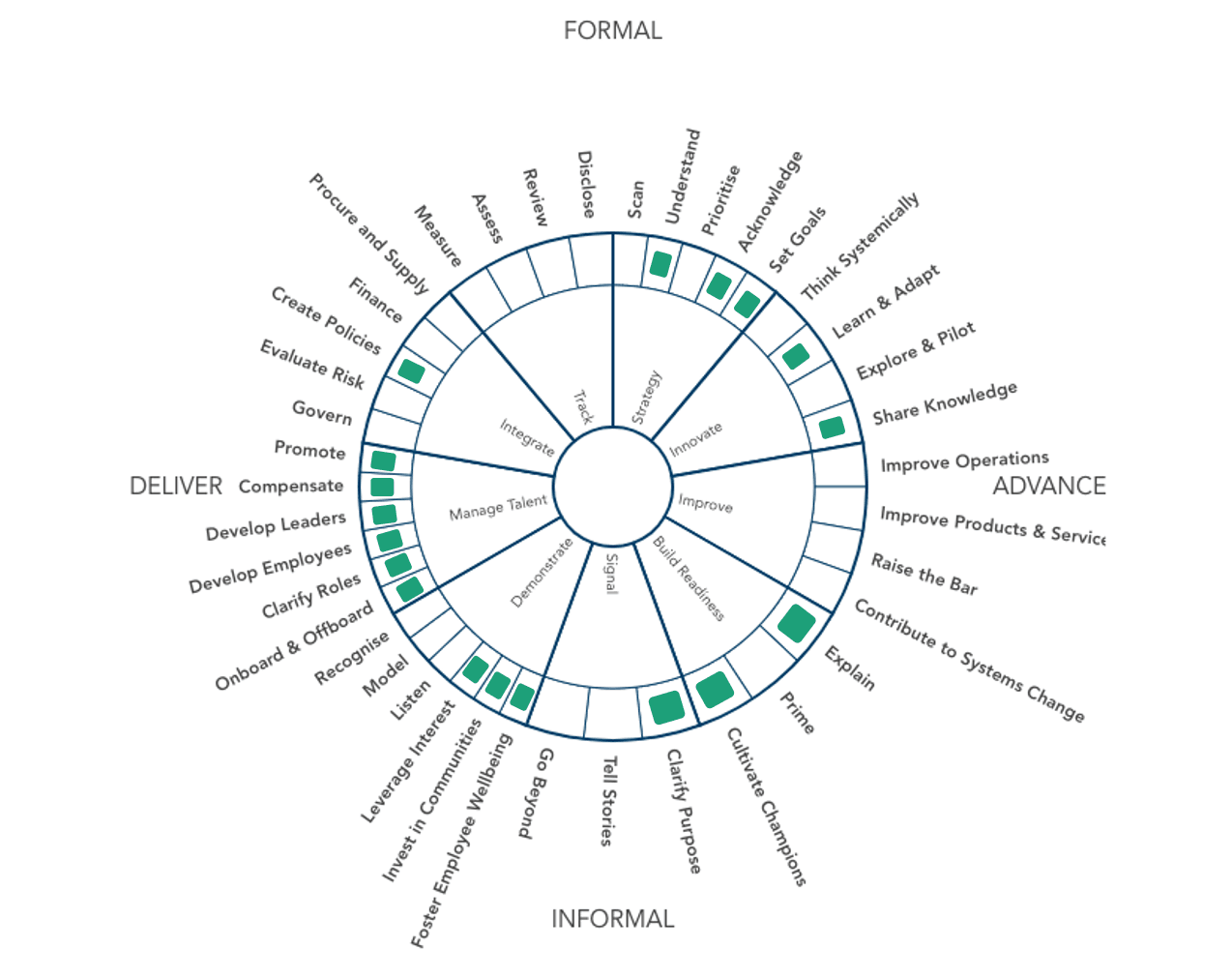
The Embedding Framework: From Planning to Behavior
The Embedding Framework helps organizations truly integrate sustainability into their daily way of working – not as a side project, but as a natural part of policy, decision-making, and behavior.
The framework outlines four key areas through which you can gradually embed sustainability into the organizational culture:
Support Engagement
Support Engagement
Clarify Expectations
Clarify Expectations
Strengthening Momentum
Strengthening Momentum
Capacity Building
Capacity Building
Inspiration for Cultural Embedding
Every organization is unique, and so is every sustainability journey. Still, there is much to learn from how others have embedded sustainability into their DNA. Below you’ll find examples of diverse companies – from family businesses to multinationals – for whom sustainability has now become second nature.
Our approach is always tailored, aligned with your culture, your challenges, and your pace. Do you recognize questions such as: How do you engage everyone? How do you translate ambitions into daily practice? Or how do you make sustainability a given? How do we handle resistance?
Get inspired by the examples below and discover what could work for your organization.
- HR team of a multinational with 7,500 employees
- A real estate organization in the housing sector.
- An international logistics service provider
A global player in the food industry connects employees with the SDGs
An international player in the food industry embraced the Sustainable Development Goals but faced a challenge: how do you engage thousands of employees worldwide in these ambitions? The organization wanted everyone – from production to marketing – to be able to contribute to the goals closest to their own passion, both at work and beyond. Since it wasn’t clear where employees’ intrinsic motivation lay, they sought a flexible program that people could join at their own convenience.
We developed a 12-month SDG program rolled out via our dedicated community app. Each month focused on a different sustainability theme. Through interactive webinars, contests, and short eLearning modules, we helped raise awareness among employees and highlighted them when they came forward with their own initiatives. Every month, we selected a ‘Champion of the Month’ who received an attractive prize package.
The result was a vibrant community where employees from different countries and departments connected around shared sustainability ambitions. The app made it possible for everyone to contribute at their own pace and time, leading to high engagement. After twelve months, the organization had not only realized concrete sustainable initiatives but, more importantly, built a community of engaged employees collaborating long-term toward a more sustainable food industry.
A family-owned business in real estate embeds sustainability into its DNA
This family-owned business in real estate development and housing had already been actively engaged in sustainability for several years. The impetus came partly from external factors: client demand and stricter regulations. But equally important was the growing drive within the family itself to make a positive contribution.
Yet, in practice, it proved difficult to get all 120 employees on board. Some had little time to delve into the new subject matter. Others were skeptical about the necessity or saw it as “just another trend.” As a result, a gap emerged: on paper, there were impressive ambitions, but in execution, they often ran into insufficient knowledge or differing interpretations.
After discussions with management, we conducted a thorough analysis of all core processes. Together with process owners, we set up a step-by-step initiative to align working methods with sustainability ambitions. We focused on concrete entry points such as the Design Requirements, procurement policy, project management, and compensation schemes.
To ensure future readiness, we built in regular review points. This kept the processes up-to-date in a rapidly changing market. The result? Sustainability was no longer a separate topic but a natural part of how they conduct business. Employees now collaborate more consistently, and the family culture gained a solid translation into daily practice.
A logistics service provider embeds sustainability at its core
This mid-sized international player in logistics managed its own fleet of trucks and vans, additionally hired external contractors, operated several warehouses, and provided specialized packaging for high-tech companies with fragile goods.
For several years, a dedicated sustainability team had been active, having largely addressed the low-hanging fruit. Now, they were looking for a way to more firmly embed sustainability into the organization’s DNA – in daily work practices and culture.
Through an intensive four-day training, the team explored all facets of the Embedding Framework. Responsibilities were collectively assigned, and ambitions were sharpened. With the insights gained, the team developed its own ‘integration agenda’ for the next five years, shaping cultural integration step by step.
Significant attention was paid to internal communication: ideas from the operational level were discussed weekly, with the important agreement that every initiative would always receive feedback. Additionally, two ambassadors were appointed – on the side of subcontracting and on the customer relations side – who continuously shared results and drove new developments. Various departments developed their own sub-plans, leading to a cohesive and consistent approach across the entire organization.
Quickly get to know the FSSD?
A proven approach for embedding sustainability in organizations
This framework is not a theoretical concept. It is a practical methodology, developed based on over 15 years of research into how organizations can successfully integrate sustainability into their culture.
Leaders in sustainability, such as Biogen, Heineken, Etsy, the Port of Vancouver, and the World Wildlife Fund (WWF), along with organizations like the World Business Council for Sustainable Development (WBCSD) and the University of Cambridge, already rely on this approach. It serves as a shared roadmap that helps your organization:
- Gain a clear and comprehensive understanding of current challenges.
- Identify the most critical steps for success.
- Develop a concrete and tailored action plan.
In short, this framework ensures that isolated initiatives merge into a coherent and lasting sustainable culture. It is a tool that has proven its value in the real-world practices of many organizations.
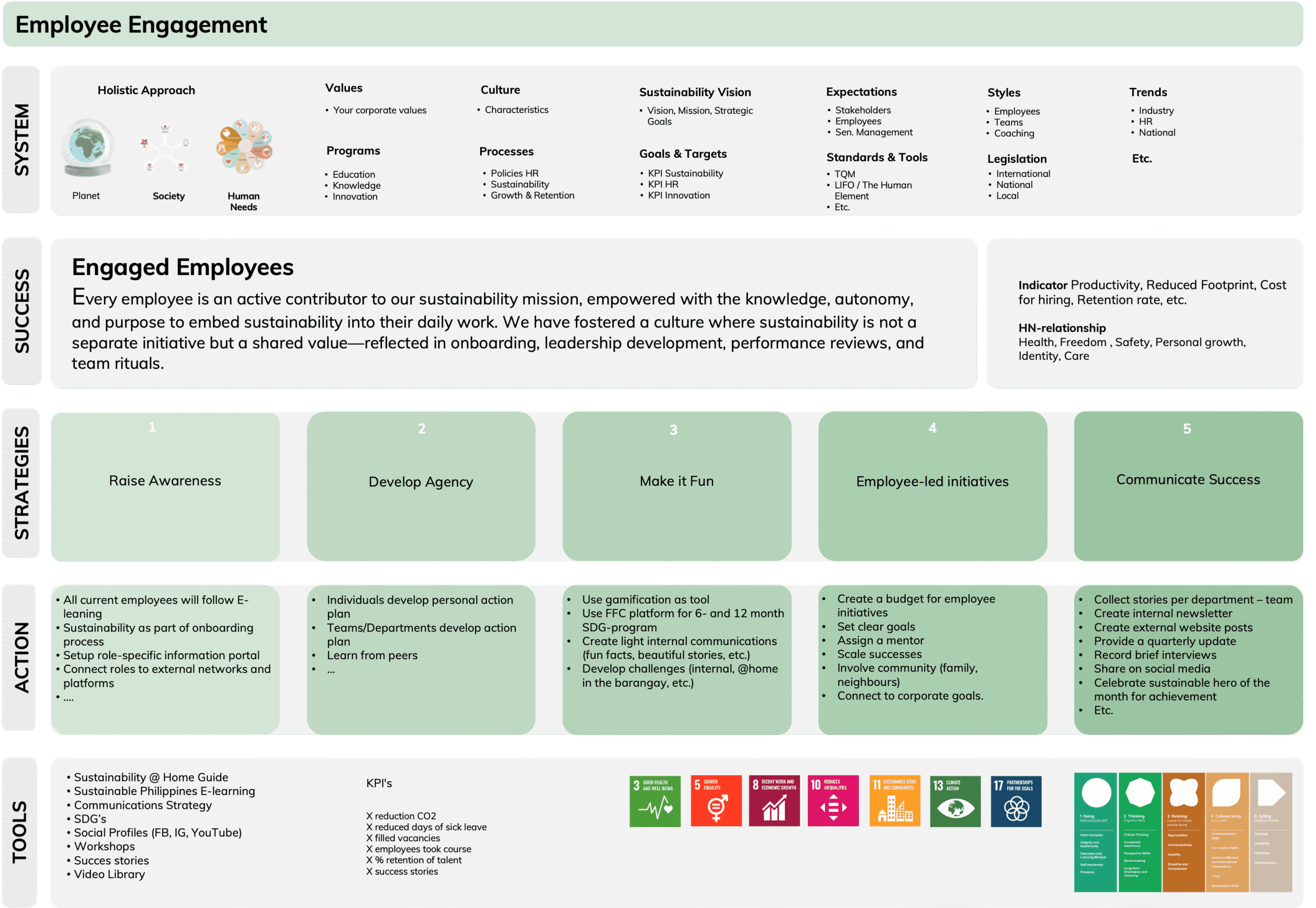

Systems Thinking Workshop
Everything is interconnected. How do we create Creative Sustainable Solutions in an immensely complex world? This 1-day workshop helps you get started!

Sustainable Culture Training
This 2-day certificate training teaches you how to leverage all facets of cultural embedding to create lasting impact with everyone's participation.

Planning for Sustainability Training
Are you on the verge of developing or revising a sustainability strategy for your company or municipality? Learn how in this international training.