

Culture is what makes the strategy work
Culture is not the soft part. It is the engine that turns the strategy into practice.
When the culture is weak, even strong leadership lowers environmental performance instead of raising it. The culture decides what the strategy gets to do.
The strategy is written. The culture has not moved yet.
Strategy describes where you want to go. Culture is where you already are. When the two do not match, the culture wins every time, even when the strategy is strong and management is fully behind it.
Formal systems
Policies, KPIs, org charts and the rules you get rewarded for. The culture as your management wrote it down.
Informal systems
How decisions get made in practice, and what people do when no one is watching. The culture as it really works.
"We have a plan, but nothing changes in the weekly meeting."
"People say the right things. The trade-offs go the wrong way."
"Sustainability is still the last item on the agenda."
Culture design: make the strategy land where the work happens
Behaviour does not change by talking about it. It changes when the system around it changes. So that is what we redesign: routines, roles, decision flows and incentives. When the system shifts, the culture follows.
A 2025 study in Sustainability identified four integration mechanisms as the strongest predictor of substantive transformation: governance, strategy, operations and performance. We work across all four, and that is where the leverage sits (Westover, 2025).
Clear ownership
No more someone should. Roles, responsibilities and decision rights defined and agreed, on paper and in practice.
Routines that reinforce the strategy
Meetings, check-ins and decision moments redesigned so sustainability shows up in normal work, not as a separate item.
Incentives that match the goals
Rewards and recognition aligned with sustainability outcomes, not delivery metrics alone.
Momentum that builds
Progress made visible, wins shared, and teams that start to pull in the same direction.
The pattern shows up in the data, not only in the client rooms
The research has converged on this. Our work is the layer your strategy has not yet built.
corporate transformations do not last. Most strategies look good on signing day and quietly fail in execution.
Harvard Business Review, Mankins and Litre, 2024Of 1,041 corporate emissions targets ending in 2020, nine percent failed and thirty-one percent disappeared without disclosure. Only three firms got media coverage.
Nature Climate Change, 2025Strong sustainability cultures develop through four observable stages, from emergence to ingrained practice. Targets set too early turn performative.
Frontiers in Psychology, 2025Three of the 13 dimensions we measure
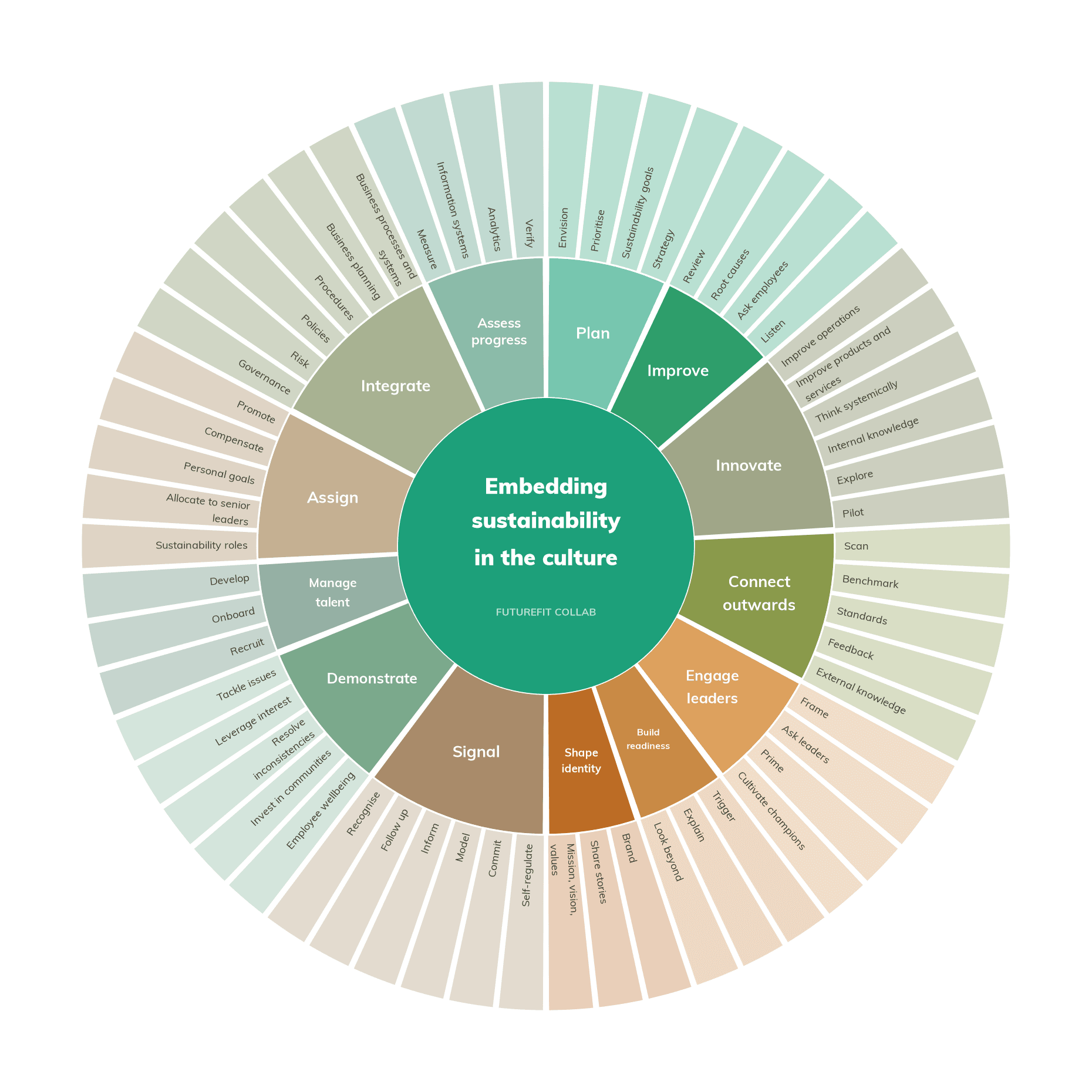
Reading the pattern from the outside is one thing. Seeing your own is the next step, and that is what the Embedding Scan is for. A 40-minute self-assessment across thirteen dimensions and 58 questions. Three of them sit close to the work this page is about.
Engage leaders
Do leaders across the organisation model the shift, or ask others to carry it for them?
Build readiness
Do people see how sustainability connects to their everyday work, or does it sit in someone else's job description?
Shape identity
Is sustainability written into your mission, vision and values, or only into your reporting?
The other ten cover strategy, governance, routines, incentives, decision rights and the systems that hold the culture together. See the full 13.
How other organisations made sustainability part of daily practice
Every organisation is different. A family firm runs differently from a scale-up, a multinational differently from a municipality. What holds across all of them: culture shifts when the sustainable choice becomes the easier one, when people understand why it matters, and when the change includes everyone.
- How do we get everyone involved, not only the core believers?
- How do we turn stated ambitions into daily decisions?
- How do we make the sustainable choice the default choice?
- How do we work through resistance without losing momentum?

HR team, multinational FMCG
Starting point
The company backed the SDGs, but employee engagement was uneven. Thousands of people across roles and countries needed a reason to join in.
How we worked
A flexible 12-month SDG programme inside a community app. Monthly themes, short eLearning, webinars and challenges, plus a Champion of the Month.
Result
A cross-country community formed. After 12 months, engagement stayed high and employee-led initiatives kept growing on their own.

COO and HR, housing and construction
Starting point
Strong ambitions, pushed by clients, rules and family values. Only part of the 300 employees felt involved, others were sceptical or too busy.
How we worked
A full scan of core processes with the process owners, then a step-by-step change plan with upgrades to design requirements, procurement, project work and reward systems.
Result
Sustainability moved from extra topic to how we work. The family values showed up in the daily decisions of 300 people.

Management team, logistics and warehousing
Starting point
A dedicated team had taken the easy wins across fleet, warehouses and packaging. Sustainability still lived with the sustainability team, not in daily choices.
How we worked
An intensive four-day Embedding Framework training with clear roles and sharper ambitions. A five-year integration agenda, plus weekly idea loops with guaranteed feedback.
Result
Ambassadors kept progress visible, departments built their own sub-plans, and one joined-up approach now runs across the organisation.
Embedding sustainable cultural change takes more than a quarter
We work on what sits underneath the report, so sustainable cultural change lands in daily behaviour. The Embedding Scan takes forty minutes and gives you a wheel of the team, in your own language. See also how we approach direction and development.
FAQ
What does the research actually say about culture and sustainability?
What is a sustainable culture?
How do you embed sustainability into organisational culture?
Why do sustainability strategies fail without culture change?
How long does sustainable culture change take?
Is now the right moment for culture and embedding work, given the politics?
Tell us what you are working on
A clear conversation about where your culture stands today and what it needs to carry the strategy. No pitch.